Login
Login


The Caspian Policy Center (CPC) in Washington, D.C., held a discussion on the results of the C6 summit in Cholpon-Ata, Kyrgyzstan, and future prospects for cooperation between Central Asian countries and Azerbaijan. The event was attended by ambassadors from five regional countries accredited to the United States, including Ambassador of Turkmenistan Esen Aydogdyev.
Opening the meeting, CPC President and CEO Efgan Nifti noted the transformation of the region from an era of border disputes and political tension to a period of dialogue and cooperation. He also emphasized Azerbaijan's growing role in Central Asia's economic agenda as a link between the Caucasus and European markets.
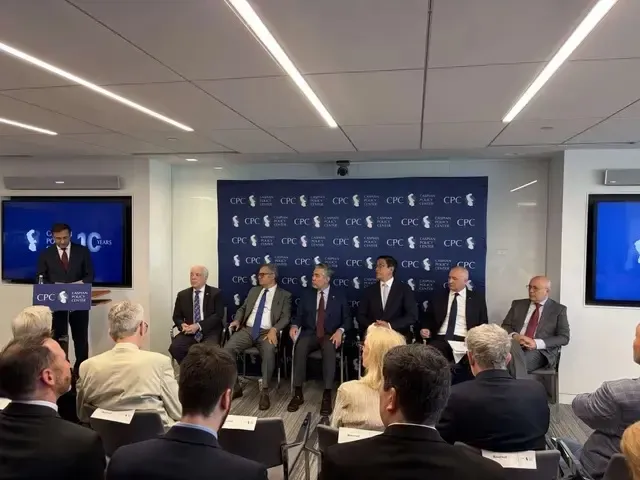
The discussion's moderator, CPC Senior Fellow Erik Rudenshold, described the Cholpon-Ata summit as another stage in the development of relations between the five Central Asian countries and Azerbaijan, noting the growing regularity and systemic nature of political dialogue in the region.
In his speech, Turkmenistan's Ambassador to the United States, Esen Aydogdyev, emphasized the growing role of the Caspian Sea as a factor in regional connectivity. According to him, the Caspian Sea is no longer a dividing line, but acts as a link between Central Asia and Azerbaijan.
Speaking about the prospects for regional cooperation, Aydogdyev prioritized achieving practical results, in particular, simplifying customs procedures. He noted that strengthening regional unity is also one of the most important outcomes that Turkmenistan is striving for.
In his speech, the ambassador paid special attention to the principle of Turkmenistan's permanent neutrality, calling it an integral part of the country's foreign policy. He emphasized that neutrality should not be interpreted as a policy of isolation: on the contrary, this position, he said, strengthens Turkmenistan's status as a reliable and predictable partner in the region, open to cooperation based on mutual benefit.
Positions of other participants in the discussion
Azerbaijani Ambassador Khazar Ibrahim stated that the results of the Cholpon-Ata summit reflect the region's achieved integrity, and Azerbaijan's participation expands the geographic scope and practical significance of the C6 format. He also noted that the Middle Corridor is already functioning as an existing transport route, not just a project for the future.
Kazakh Ambassador Magzhan Ilyasov emphasized the importance of developing regional economic ties and creating conditions for stable dialogue between all five Central Asian countries, and expressed interest in maintaining a high level of U.S. engagement.
Ambassador of the Kyrgyz Republic Edil Baisalov, representing the host country of the summit, noted the growing awareness among countries in the region of their ability to independently resolve internal issues and strengthen unity without external interference. Among the specific results of cooperation, he highlighted the development of transport connectivity, including the China-Kyrgyzstan-Uzbekistan railway.
Uzbek Ambassador Furkat Sidikov described the summit as a continuation of President Shavkat Mirziyoyev's course to strengthen political partnerships in the region. He also reported a significant increase in the number of joint ventures between Uzbekistan and Central Asian countries - from about 300 in 2017 to about 1500 currently, and noted the country's interest in the digitalization of the Middle Corridor.
Following the discussion, participants noted that the region is consistently moving toward practical, results-oriented cooperation in the areas of transport, energy, customs regulation, digital connectivity, investment, water resources, ecology, and tourism. The discussion concluded with a question and answer session, during which investment opportunities and prospects for further US involvement in Central Asia were discussed.